
India’s fruit juice market crossed $5.2 billion in 2024 and continues climbing steadily, fueled by something more interesting than simple thirst — a genuine, sustained shift among urban Indians away from carbonated soft drinks toward beverages that at least sound healthier. That shift has turned packaged juice into one of the more actively contested categories in Indian FMCG, with legacy players and newer challenger brands competing directly for a shopper who increasingly reads the ingredient label before reaching for the bottle.
Real
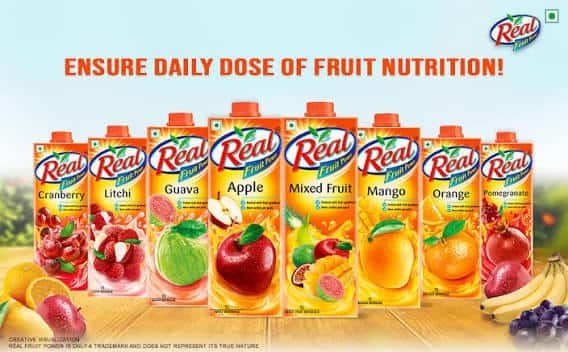
Real, Dabur’s flagship juice brand, has historically commanded a genuinely dominant position in India’s packaged juice category, built on a formulation using concentrated fruit juices without added color, flavor, or preservatives. This clean-label positioning aligns closely with rising consumer demand for ingredient transparency, and Dabur’s extensive existing distribution network — already well-established through its broader consumer health and personal care portfolio — gives Real considerable reach across both urban and semi-urban Indian markets. The brand’s scale and consistent presence across retail formats have made it one of the most recognized names when Indian consumers think of packaged fruit juice specifically.
Tropicana
Tropicana, owned by PepsiCo, entered the Indian market formally in 2014 through a partnership with Varun Beverages, bringing global brand recognition into a market already dominated by established domestic players. The brand offers two distinct product lines — Tropicana Delight, focused on carton-packed fruit juice, and Tropicana Slice, a PET-bottled mango juice drink built on the legacy Slice brand PepsiCo had originally introduced in India decades earlier. PepsiCo has continued expanding Tropicana’s health credentials specifically, positioning the brand toward premium, health-conscious consumers with a wide variety of fruit blends and nutritionally fortified options.
Minute Maid
Minute Maid, manufactured by Coca-Cola in India, leverages the parent company’s unmatched national distribution infrastructure — reportedly reaching between 250 and 350 million retail touchpoints across the country — giving the brand genuine, pervasive availability that few competitors can match logistically. Coca-Cola’s broader beverage strategy has increasingly emphasized health-oriented portfolio additions across its range, and Minute Maid benefits directly from this positioning shift as the company works to capture health-conscious consumers migrating away from its traditional carbonated soft drink business.
Frooti
Frooti, from Parle Agro, occupies a genuinely distinct position in the Indian juice category as one of the most recognized mango drink brands in the country, built on decades of consistent brand presence and youth-oriented marketing. While technically classified more as a fruit drink than a 100% juice product, Frooti’s sheer market recognition and cultural presence in India make it impossible to leave out of any serious discussion of the country’s juice and juice-adjacent beverage landscape. Parle Agro’s broader beverage portfolio and distribution strength give Frooti continued relevance even as more health-focused, higher-fruit-content brands gain ground among increasingly label-conscious shoppers.
Paper Boat
Paper Boat, from Hector Beverages, has built a genuinely distinctive identity around nostalgic, traditional Indian flavors — aam panna, jaljeera, and kokum among others — positioned as a premium, culturally rooted alternative to the more conventional orange and mixed-fruit juice offerings dominating the category. This nostalgia-driven, storytelling-heavy brand positioning has resonated particularly well with urban millennial consumers specifically seeking beverages that feel authentically Indian rather than globally generic. Paper Boat’s premium pricing and distinctive packaging reflect a deliberate strategy of competing on emotional connection and flavor differentiation rather than pure distribution scale.
What’s Genuinely Reshaping the Category
The most significant shift underway is the consumer migration from carbonated soft drinks toward fruit-based beverages, driven by rising awareness around nutrition, immunity, and ingredient quality. This has pushed nearly every major player toward real fruit content emphasis, lower sugar formulations, and cleaner ingredient labels as genuine competitive differentiators rather than optional marketing extras. Quick commerce platforms and expanding retail distribution have also accelerated category growth considerably, making ready-to-drink juice more impulsively accessible to urban consumers than it’s ever been.
Global trends are influencing the Indian market too — the worldwide expansion of sugar taxes across dozens of jurisdictions and growing demand for minimally processed, functionally fortified beverages are pushing manufacturers everywhere, including in India, toward reformulating existing products and launching genuinely lower-sugar variants rather than treating health positioning as pure marketing language.
The Bottom Line
Real and Tropicana continue anchoring the mainstream, health-positioned juice segment through established distribution and clean-label credibility, Minute Maid leverages Coca-Cola’s unmatched national reach, and Frooti and Paper Boat each carve out genuinely distinct positions through cultural familiarity and nostalgic premium storytelling respectively. With India’s fruit juice market continuing to grow steadily on the back of health-conscious consumer migration away from carbonated drinks, these five brands collectively represent the clearest picture of where Indian juice buying is heading in 2026.
FAQs
Q1. What’s the difference between a “juice” and a “fruit drink” like Frooti, and does it matter for nutrition?
A genuine 100% juice product contains only fruit content and water without added sugar syrups or artificial flavoring beyond what natural fruit provides, while a fruit drink like Frooti typically contains a lower percentage of actual fruit juice blended with added sugar and water. Checking the specific fruit content percentage listed on the packaging gives you a more accurate nutritional picture than assuming based on brand positioning or marketing language alone.
Q2. Is Real or Tropicana genuinely healthier, given both claim to use real fruit without added preservatives?
Both brands generally offer comparable nutritional profiles within their standard product lines, since both emphasize real fruit concentrate and avoid added colors in their core offerings, though sugar content and specific formulations can vary between individual product variants within each brand’s range. Comparing the actual nutrition label — particularly added sugar content — between the specific products you’re considering gives a more reliable answer than relying on either brand’s general reputation.
Q3. Why has Paper Boat positioned itself as a premium brand instead of competing directly on price with Real or Tropicana?
Paper Boat deliberately built its identity around nostalgic, traditional Indian flavors and distinctive storytelling-driven packaging, appealing to a specific urban, culturally connected consumer segment willing to pay more for that emotional and flavor differentiation. This premium positioning lets the brand avoid direct price competition against larger, more distribution-heavy players like Real and Tropicana, instead building loyalty through genuine product uniqueness rather than trying to out-scale much larger competitors.
Q4. Are lower-sugar juice variants from major brands actually significantly better for daily consumption?
Lower-sugar variants generally do reduce overall calorie and sugar intake meaningfully compared to standard formulations, which matters if you’re consuming packaged juice regularly rather than occasionally. That said, even reduced-sugar fruit juice still contains natural sugars and lacks the fiber of whole fruit, so it’s worth treating packaged juice, regardless of sugar level, as a complement to whole fruit intake rather than a full nutritional substitute for it.