
Two brands alone account for more than 80% of India’s entire instant soup market — a level of concentration even more extreme than the country’s ketchup or cereal categories. That’s a genuinely striking statistic for a category built on convenience, where you’d expect dozens of interchangeable players to be splitting shelf space fairly evenly. Instead, a small handful of names have made themselves the default answer whenever an Indian household reaches for a warm, quick meal.
Knorr
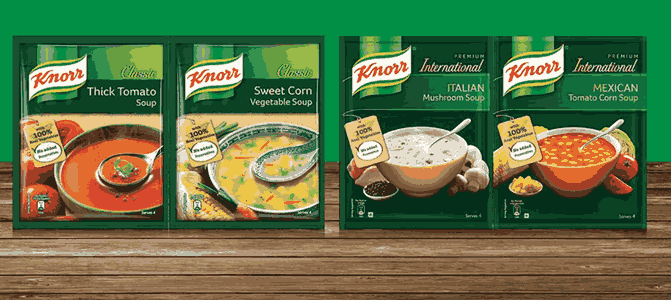
Knorr, under Hindustan Unilever, is one of the two brands that together dominate over 80% of India’s instant soup market, and its position rests on genuine category breadth and consistent quality across a wide flavor range. The brand spans classic Western-style soups like tomato and sweet corn alongside more Indo-Chinese leaning options, giving it relevance across nearly every Indian consumer’s taste preference. Knorr’s strong retail penetration, combined with HUL’s extensive distribution network across both metro and smaller-city markets, has helped cement its position as the category’s most recognized name for everyday, dependable instant soup.
Ching’s Secret
Ching’s Secret, from Capital Foods, is the other half of the market’s dominant duo, having built its entire identity around authentic Indo-Chinese flavor profiles that resonate strongly with younger Indian consumers specifically. Its Manchow and Hot & Sour soup variants remain among the most popular options in the entire category, particularly favored by students and young adults seeking bold, spicy flavors over milder Western-style options. Ching’s success reflects a broader shift in Indian instant food more generally, where Indo-Chinese cuisine has moved from restaurant novelty to genuine everyday comfort food.
Maggi
Maggi, under Nestlé, extends its enormous instant noodles brand trust directly into the soup category, offering a range spanning classic tomato and mixed vegetable through to hot and sour and lemon coriander variants. This flavor breadth gives Maggi genuine appeal across a wide age range, and the brand’s decades-long reputation for quick preparation and consistently reliable taste transfers naturally from its noodle business into soups. While Maggi doesn’t match Knorr or Ching’s combined market dominance, its brand recognition alone ensures it remains a consistently visible, trusted choice on Indian shelves.
Bambino
Bambino has carved out a genuinely distinct position by focusing specifically on traditional, nostalgic Indian flavors rather than competing purely on Western or Indo-Chinese profiles. Its range includes options like masoor dal soup alongside more familiar tomato and pepper combinations, appealing directly to consumers seeking authentic Indian taste in convenient, instant format. This nostalgia-driven positioning gives Bambino a loyal niche following distinct from the broader mass-market appeal that Knorr and Ching’s have built their dominance around.
MTR
MTR brings its established South Indian food heritage into the instant soup category, leveraging decades of trust built through its broader ready-to-eat and instant food portfolio across South Indian households specifically. As one of the recognized players operating in India’s instant soup market, MTR benefits from strong regional brand loyalty and a reputation for authentic South Indian flavor execution that larger, more broadly positioned national brands don’t always replicate as convincingly.
What Indian Consumers Are Actually Choosing
Instant tomato soup remains the single most popular flavor choice across the entire category, largely because its familiar taste appeals consistently across age groups and regional preferences. Beyond tomato, Indian soup preferences span several genuinely distinct categories: creamy options like mushroom and sweet corn valued for rich texture, clear soups favored by fitness-conscious consumers wanting something lighter, and the Indo-Chinese Manchow and Hot & Sour varieties that remain particular favorites among students and young adults specifically.
Growing health awareness has also meaningfully boosted the organic and preservative-free soup segment, with clear front-of-package labeling increasingly used to build trust and differentiate cleaner-label products from conventional instant soup formulations.
What’s Driving Category Growth
Single-serve packaging has become genuinely essential rather than optional in 2026, driven by portion control benefits and reduced wastage compared to larger family-sized packs. This shift has been reinforced by workplace consumption patterns specifically, where hygienic, vending-machine-compatible formats have become a real requirement for office and shared-space settings. Pricing plays a meaningful role in purchasing decisions too — standard single-serve packs typically sell in the ₹10-12 range, while premium single-serve products command ₹20-30, and higher-protein meal-replacement soup options can run considerably higher per multi-serving pack.
The Bottom Line
Knorr and Ching’s Secret together command an overwhelming majority of India’s instant soup market, splitting dominance between broad Western-style appeal and bold Indo-Chinese flavor positioning respectively, while Maggi, Bambino, and MTR each carve out meaningful, more specialized niches around brand trust, nostalgic Indian flavors, and regional South Indian heritage. With single-serve convenience and health-conscious formulations continuing to reshape the category, these five established names remain the clearest starting points for navigating India’s rapidly growing instant soup shelf.
FAQs
Q1. Why do Knorr and Ching’s Secret dominate the instant soup market so heavily compared to other brands?
Their combined dominance largely comes down to broad flavor coverage matched to distinct consumer preferences — Knorr spans both Western and Indo-Chinese profiles broadly, while Ching’s specifically owns the bold, spicy Indo-Chinese niche that resonates strongly with younger consumers. This combination of broad appeal and focused specialization has made it genuinely difficult for other brands to carve out comparable market share.
Q2. Are organic or preservative-free instant soups genuinely healthier than standard options, or is that mostly marketing?
Preservative-free formulations generally do contain fewer artificial additives, which appeals to health-conscious buyers, though it’s worth checking the specific sodium and overall nutritional content rather than assuming “organic” or “preservative-free” automatically means significantly healthier across every metric. Comparing the actual nutrition label between a standard and a premium health-focused variant from the same brand often reveals a more nuanced picture than the front-of-package claims suggest.
Q3. Is it worth paying more for a premium single-serve soup cup compared to standard sachet packs?
Premium single-serve cups typically offer added convenience — often just requiring hot water with no separate bowl needed — along with more consistent preparation quality, which can justify the higher price for office or on-the-go use specifically. For home preparation where convenience matters less and you’re not paying for the cup format itself, standard sachet packs generally offer better value for essentially the same soup quality.
Q4. Which instant soup brand is best if I specifically want authentic Indian flavors rather than Western-style options?
Bambino has built its identity specifically around traditional, nostalgic Indian flavors like masoor dal soup, making it a strong choice if that’s your specific preference over more Western-leaning tomato or mushroom varieties. MTR is also worth considering if you’re specifically drawn to South Indian flavor profiles, given the brand’s decades-long heritage and trust within that regional culinary tradition.