
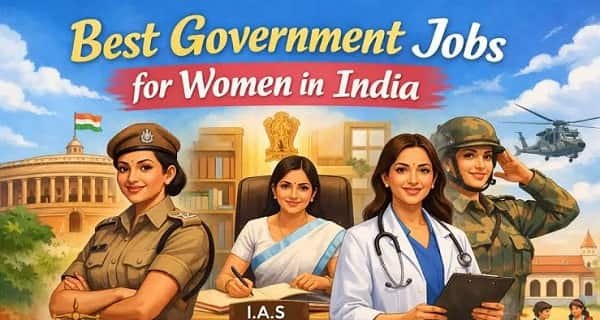
Government employment has undergone a transformation in how it relates to women over the past decade. Women IAS officers at the top of the civil services. Female fighter pilots flying IAF missions. Women NDA cadets completing the full defence academy training since the Supreme Court order of 2022. State police forces running dedicated Mahila Battalions and reserving 30–33% of constable vacancies for women across multiple states.
These are not symbolic gestures. They are structural changes in how Indian government institutions recruit and deploy women, and they have made government careers more genuinely accessible than at any previous point.
Beyond the high-profile roles, the daily reality of government employment matters. Fixed working hours. Maternity leave of 26 weeks under central government rules. Child care leave provisions. Job security that private sector employment cannot match. Local posting preferences for women in many departments. The 33% women’s reservation in panchayat-level government positions. The 8th Pay Commission recommendations — expected to be implemented from January 2026 — projecting a 25–34% salary hike for central government employees.
For female students and graduates weighing career options, government employment offers a package of financial stability, institutional protection, and long-term security that has significant practical value alongside the professional opportunity.
| Government Job / Exam | Eligibility | Salary Range | Women-Specific Benefit |
| UPSC Civil Services (IAS/IPS/IFS) | Any graduate | ₹56,100/month basic + perks | Maternity leave, accommodation, security |
| SSC CGL | Any graduate | ₹44,900 – ₹47,600/month basic | Office-based posting, desk roles |
| IBPS PO / SBI PO | Any graduate | ₹35,000 – ₹50,000/month (gross) | Maternity benefits, leave provisions |
| RBI Grade B | Any graduate | ₹1.25 – 1.5 lakh/month gross | Structured hours, residential quarters |
| SEBI Grade A | Any graduate | ₹62,500 – ₹1.26 lakh/month | Regulatory career, Mumbai posting |
| State Police (SI / Constable) | 12th / Graduate | ₹25,000 – ₹60,000/month | 30–33% reservation in many states |
| Indian Defence (CDS / AFCAT / Agniveer) | Graduate / 12th | ₹56,100/month (officer) | Expanded roles post-2022 |
| Teaching (KVS/NVS/State) | Graduate + B.Ed | ₹35,000 – ₹70,000/month | Academic calendar, summer leave |
| NABARD / SIDBI Grade A | Graduate | ₹44,500 – ₹55,200/month | Development banking, structured hours |
| Judiciary (State Judicial Services) | LLB graduate | ₹77,000 – ₹90,000/month basic | Independent authority, prestige |
UPSC Civil Services: The Most Impactful Choice
The Indian Administrative Service, Indian Police Service, and Indian Foreign Service represent the most powerful careers available through government examination — and women are claiming a growing share of them. Recent UPSC Civil Services results have seen women constitute over 30% of the final list, with multiple women topping the examination overall.
An IAS officer’s effective compensation — base pay of ₹56,100/month plus DA, HRA, transport allowance, government housing, household staff, official vehicle, medical facilities, and retirement pension — is substantially higher in real value than the basic salary figure suggests. In major postings, the effective monthly benefit package exceeds ₹1.5 – 2 lakh when housing and perquisites are valued. The 8th Pay Commission is expected to revise basic pay upward by 25–34% once implemented, with arrears from January 2026.
Beyond compensation, the career itself is unique. District Magistrates manage governance over populations larger than many European countries. IPS officers lead law enforcement operations. IFS officers represent India’s diplomatic interests globally. Female officers in all three services have demonstrated that the challenges of these roles are not gender-specific.
The examination requires typically two to four years of dedicated preparation after graduation. Arts, Commerce, and Science graduates are all eligible. Women who begin building UPSC habits — daily newspaper reading, current affairs awareness, answer writing practice — during undergraduate years are meaningfully ahead of those who begin only after graduation.
SSC CGL: Accessible, Stable, Widely Respected
SSC CGL is the most popular graduate-level central government examination, and it recruits for roles that offer desk-based working environments, fixed hours, and careers in central government departments including Income Tax, Customs, CBI, Enforcement Directorate, and various ministries.
Women are particularly well-represented in SSC CGL selections because the examination tests aptitude, reasoning, and general awareness — skills that women candidates develop equally to men through standard preparation. Income Tax Inspector, Assistant Audit Officer, and Sub-Inspector (Central Bureau of Narcotics) are among the more sought-after SSC CGL posts. Starting pay at Level 7 is ₹44,900 basic, with effective monthly income around ₹55,000 – ₹75,000 in metro cities after allowances.
The working environment in central government offices offers maternity benefits, childcare leave, and protection under the POSH Act for workplace safety — provisions that vary significantly in quality and implementation across private sector employers.
Banking: IBPS PO, SBI PO, and RBI Grade B
Public sector banking is one of the most actively female-friendly segments of government employment in India. SBI alone has over 25% women officers. The working environment is structured, harassment policies are formally implemented, and maternity and childcare benefits are more consistently delivered than in most private sector organisations.
IBPS PO gross monthly salary in metro cities sits around ₹80,000 – ₹90,000 per month under the 12th Bipartite Settlement. SBI PO packages are comparable. Promotion cycles in public sector banks are reasonably structured — from Probationary Officer to Scale II, Scale III, and upward — with performance and service playing the primary roles.
RBI Grade B represents a distinct tier above commercial banking. Grade B Officers at the Reserve Bank work on monetary policy, banking regulation, and financial supervision — substantive intellectual work with a gross monthly compensation of ₹1.25 – 1.5 lakh in Mumbai and Delhi. The working environment at RBI is considered among the most structured and professionally respectful in the government financial sector. Women officers at RBI consistently report strong institutional support for career development.
SEBI Grade A
SEBI (Securities and Exchange Board of India) Grade A Officers work on capital markets regulation — perhaps the most intellectually demanding and financially well-compensated regulatory career in the central government structure below the IAS. The salary range of ₹62,500 – ₹1,26,100 per month, combined with NPS contribution, DA, and other allowances, makes SEBI one of the better-compensated central government positions available to graduates.
The examination tests finance, economics, and management knowledge alongside general aptitude. Law and commerce graduates with strong financial markets understanding are particularly competitive. The Mumbai posting — where SEBI headquarters is located — offers access to India’s financial capital alongside a structured institutional environment with defined working hours.
Defence Forces: Expanded Opportunities for Women
The expansion of women’s roles in India’s defence forces has been one of the most significant institutional changes in recent years. The Supreme Court’s 2022 order admitting women to the National Defence Academy opened the full officer pipeline — previously closed — to female candidates. Women have served as Indian Air Force fighter pilots since 2016. The Indian Coast Guard, Assam Rifles, and several other paramilitary organisations have created dedicated women’s wings.
Currently accessible routes for women:
CDS (Combined Defence Services): Open to women graduates for OTA (Officers Training Academy) entry. Commissioned officer salary at Level 10 is ₹56,100 basic plus Military Service Pay and allowances.
AFCAT: Air Force Common Admission Test for Flying, Ground Duty (Technical), and Ground Duty (Non-Technical) branches. Women are commissioned in Ground Duty branches and the Flying branch.
Agniveer: The four-year contract scheme recruits women for Army General Duty and Clerk categories. Starting monthly package is ₹21,000 (Year 1) scaling to ₹28,000 (Year 4) with additional benefits.
Paramilitary Forces: CRPF, CISF, BSF, and SSB all have women constable and officer recruitment. Starting salaries range from ₹21,700 to ₹30,000 per month for constable grades.
State Police: Strong Reservation, Local Posting
State police recruitment offers women one of the most directly accessible government career pathways, with reservation quotas that are among the highest of any government sector. Multiple states — Uttar Pradesh, Maharashtra, Bihar, Tamil Nadu, Madhya Pradesh, Rajasthan, and Karnataka — reserve 30–33% of police constable and sub-inspector vacancies for women. Several states run dedicated Mahila Battalions.
Sub-Inspector salary in most states starts between ₹35,000 – ₹60,000 per month with allowances. Police Constable salary begins at ₹25,000 – ₹35,000 per month. Both roles carry government medical benefits, housing allowances in many postings, and structured promotion pathways. The physical fitness requirements — which vary by state — are manageable with preparation, and written examinations favour candidates with strong general knowledge and reasoning ability.
State police careers are particularly relevant for women who want to remain in or near their home city, as constable and SI postings frequently align with home-district preferences for women candidates.
Teaching Government Jobs: KVS, NVS, and State Schools
Teaching remains the single largest employer of educated women in government service, and the case for it goes beyond tradition. Kendriya Vidyalaya Sangathan (KVS), Navodaya Vidyalaya Samiti (NVS), and state government school systems all offer structured pay scales, defined academic calendars, and working environments that are among the most consistently female-friendly in public employment.
KVS Primary Teachers earn ₹35,400 – ₹44,900 basic at entry level. Graduate Teachers earn ₹44,900 – ₹47,600. Post Graduate Teachers and Vice Principals earn ₹47,600 – ₹56,100. With DA and allowances, effective monthly compensation in metro cities is substantially higher than basic figures. Central government school teachers also get academic calendar alignment — summer and winter vacations, examination leave — that provides genuine scheduling flexibility.
UGC NET-qualified women seeking university positions as assistant professors start at pay Level 10 (₹57,700 basic) at central universities, with associate professor and professor scales significantly higher. Academic careers also offer sabbatical provisions, research funding access, and the intellectual engagement of working with advanced subject matter continuously.
Judiciary: State Judicial Services
For LLB graduates, State Judicial Services Examinations offer one of the most structured and prestigious government career pathways. Civil Judges and Judicial Magistrates are appointed through competitive examination. Starting pay under the 7th Pay Commission is approximately ₹77,840 per month for Civil Judges. District Judges earn substantially more at post scale.
The judiciary offers a career with genuine professional independence — judicial officers exercise legal authority that is not subject to executive direction in their decisions. For female lawyers, judicial service provides both institutional respect and the security of a government career without the business development pressure of independent legal practice. Women judges are present at every level of the Indian judiciary, including as Chief Justices of High Courts, demonstrating that the highest levels are accessible.
NABARD and Development Finance
NABARD Grade A (Assistant Manager) and Grade B (Manager) roles attract graduates interested in rural development, agricultural finance, and cooperative banking regulation. The working environment is considered among the most professionally respectful in public sector finance, with structured hours and strong institutional culture.
Entry salaries for NABARD Grade A are approximately ₹44,500 – ₹55,200 basic per month. The work — rural credit flow, SHG financing, agricultural infrastructure investment — has genuine developmental significance beyond financial management. Women with economics, finance, or agriculture backgrounds find NABARD examinations aligned with their educational preparation.
Frequently Asked Questions
Q: Is there reservation for women in central government jobs like IAS and SSC?
A: Central government examinations — UPSC Civil Services, SSC CGL, IBPS — do not have a central women’s reservation quota. However, age relaxation is sometimes provided for women in state-level examinations. The 33% women’s reservation applies primarily to panchayat-level elected positions and several state police forces. Women compete on merit in central examinations and are succeeding at high rates.
Q: Which government job is best for women who want to remain in their home city?
A: State government teaching recruitment (CTET/TET followed by state school teacher hiring), state PSC administrative posts, and state police recruitment all frequently accommodate home-district or home-state preferences for women candidates. Central government posts involve all-India posting, though women officers in many departments receive sympathetic consideration for posting preferences.
Q: What maternity benefits are available in government jobs?
A: Central government female employees receive 26 weeks of paid maternity leave under the Maternity Benefit (Amendment) Act 2017, plus two years of childcare leave (CCL) that can be taken in instalments for children up to 18 years of age. These provisions apply across IAS, banking, SSC, teaching, and PSU government roles. Private sector implementation of these benefits is variable and frequently contested.
Q: Is the physical fitness requirement in police and defence jobs a barrier for most women?
A: The physical standards for women in police and defence recruitment are defined separately from men’s standards and are designed to be achievable with structured preparation over three to six months. Women who begin physical training — running, strength, and endurance — six months before the examination consistently meet these standards. The mental preparation and written examination are equal determinants of selection success.
Q: How does the 8th Pay Commission affect government job salaries for women?
A: The 8th Pay Commission, constituted in November 2025 with recommendations targeted for effect from January 2026, is projected to increase basic pay by approximately 25–34% through a revised fitment factor. Once formally implemented — actual salary payment with arrears is expected in 2026 or 2027 — all central government employees including women will see their basic pay revised upward. This makes the financial case for government careers stronger, not weaker, in the near term.