
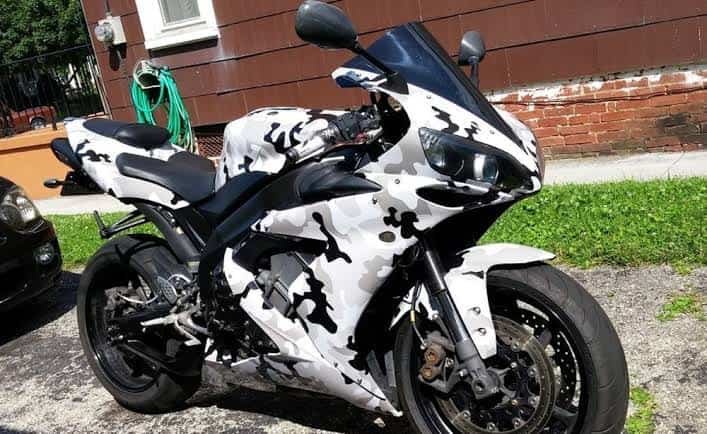
The short answer: bike wrapping itself isn’t illegal, but changing your bike’s color through a wrap without updating your Registration Certificate (RC) is. This is one of those topics where the material (vinyl wrap) isn’t the issue at all — what matters legally is whether the result matches what’s officially recorded for your vehicle. A wrap that keeps your bike’s original color, or a transparent protective film, sits on entirely solid legal ground. A full-color wrap that doesn’t match your RC puts you in violation of the Motor Vehicles Act, even though the underlying technology and trend are completely mainstream.
The Law Behind This: Section 52 of the Motor Vehicles Act
The governing provision here is Section 52 of the Motor Vehicles Act, 1988, read alongside the Central Motor Vehicles Rules (CMVR). This section prohibits any alteration to a vehicle’s specifications — as recorded in its Registration Certificate — without prior approval from the registering authority (your local RTO).
This isn’t a law written specifically about wraps; it’s a broader rule governing any change to your vehicle’s registered details, and color is explicitly one of those details. Your RC lists your bike’s color, among other specifics, and the law requires that what’s actually on the road matches what’s on that document.
So if your bike is registered as “red” in your RC, and you wrap it entirely in matte black, your vehicle’s appearance no longer matches its official registration — and that discrepancy is exactly what the law is designed to catch.
Why This Rule Exists
This isn’t bureaucratic box-checking for its own sake. The reasoning given consistently is:
- Vehicle identification and theft prevention. If vehicle color could be freely changed without any record, it would become significantly easier for a stolen vehicle to be disguised and pass a casual check, since color is one of the first and most obvious identifiers used to spot a mismatch.
- Consistency between a vehicle’s legal identity and its physical appearance, which matters for everything from insurance claims to police verification during routine stops or accident investigations.
What’s Clearly Legal
A few specific scenarios are unambiguous and don’t require any RTO involvement at all:
- A wrap that matches your bike’s original, RC-registered color. Since there’s no actual discrepancy between what’s on paper and what’s on the road, this doesn’t create the legal problem the rule is designed to prevent — though it’s worth noting this specific scenario (same-color wrap) sits in a bit of a practical gray area simply because it’s unusual enough that most RTOs and traffic police have no established process for or interest in checking it, rather than being explicitly blessed by name in the law.
- Transparent Paint Protection Film (PPF). This is the clearest, safest option of all. PPF is designed specifically to protect your bike’s original paint without altering its color or appearance in any way. Since it doesn’t change what’s visually presented or what’s recorded in your RC, it’s fully legal without any approval process.
- Decals, graphics, and stickers that don’t drastically change the bike’s primary color. Aesthetic additions — stripes, logos, racing graphics — that leave the base color recognizably intact are generally treated as acceptable without needing RTO sign-off.
What Requires RTO Approval
A wrap that changes your bike’s actual color — the scenario most people picture when they think of “bike wrapping” — needs to go through a formal process:
- Visit your local RTO with your RC book and a sample of the new color/wrap you intend to apply.
- Fill out the relevant color-change form (commonly referred to as the NAVM form in older processes) to formally notify the RTO of the intended change.
- Get the change approved before or shortly after the wrap is applied.
- As of recent amendment rules (2025), workshops are required to issue Form 22G, certifying that the modification meets CMVR standards — an added layer of documentation specifically for color-change work done through a registered workshop.
- Get your RC officially updated to reflect the new color, completing the legal process.
Only once this is done is a color-changing wrap considered fully compliant — not just “technically tolerated,” but genuinely matching your legal registration.
What Happens If You Skip This Process
Riding with a color-changing wrap that doesn’t match your RC, without having gone through the approval and update process, carries real consequences if you’re checked:
- Fines issued by traffic police during a routine stop or inspection
- RC suspension or cancellation in more serious enforcement scenarios
- Vehicle seizure, particularly if the mismatch raises suspicion during a check (for instance, at a checkpoint focused on stolen vehicles)
- Complications with insurance claims, since insurers may question discrepancies between your registered vehicle details and its actual appearance at the time of an incident
The Practical Reality on Indian Roads
It’s worth being honest about how this plays out day to day: full-body color-changing wraps are genuinely common across Indian cities, and most riders who apply them never visit an RTO to formalize the change. Enforcement tends to be inconsistent — a wrap matching or closely resembling the original color is unlikely to draw scrutiny, while a dramatically different wrap color is more likely to raise questions if you’re stopped, particularly during stricter enforcement drives or vehicle verification checks. That said, “many people do it without consequence” isn’t the same as “it’s legal” — the gap between common practice and the letter of the law here is real, and riders who want to be fully compliant (not just unlikely to get caught) need to go through the RTO update process for any genuine color change.
A Simple Way to Think About It
- Want to protect your paint without changing its look? Go with transparent PPF — no RTO visit needed.
- Want graphics, stripes, or decals that don’t fundamentally change your bike’s primary color? Generally fine without formal approval.
- Want a genuine, different-color full wrap? Technically requires the RTO approval and RC update process to be fully legal — skipping this step means you’re riding in violation of Section 52, even though enforcement is inconsistent in practice.
Frequently Asked Questions
Q1. Do I need to inform the RTO if I wrap my bike in a color that’s very close to, but not exactly, my original RC color?
This remains a genuine gray area without a clear legal standard for “close enough,” so the safest approach if you want to avoid any ambiguity is to either match the original color precisely or go through the formal RTO color-change process if there’s any meaningful visible difference.
Q2. Is a transparent wrap or PPF something I need to report to the RTO?
No — since PPF doesn’t alter your bike’s color or appearance, it doesn’t trigger the RC-mismatch issue that color-changing wraps do, making it fully legal without any approval process.
Q3. What’s the actual risk if I just wrap my bike in a new color and never update the RC?
You’re technically in violation of Section 52 of the Motor Vehicles Act, which could result in fines, RC suspension, or vehicle seizure if checked by traffic police or during a vehicle verification drive, though enforcement in practice varies significantly and many riders go unchecked.
Q4. Does removing a color-changing wrap and reverting to the original paint fix any legal issue retroactively?
Yes, in the sense that once removed, your bike’s appearance matches your RC again, resolving the discrepancy going forward — though this doesn’t retroactively address any fine or legal action that may have already been taken while the mismatched wrap was in place.