
Yes, recording a phone call is legal in India — provided you’re actually a participant in that call. India follows what’s called a one-party consent standard: if you’re on the call yourself, you can record it without needing to tell or get permission from the other person. What’s clearly illegal is recording a conversation you’re not part of, or intercepting someone else’s call without any participant’s consent.
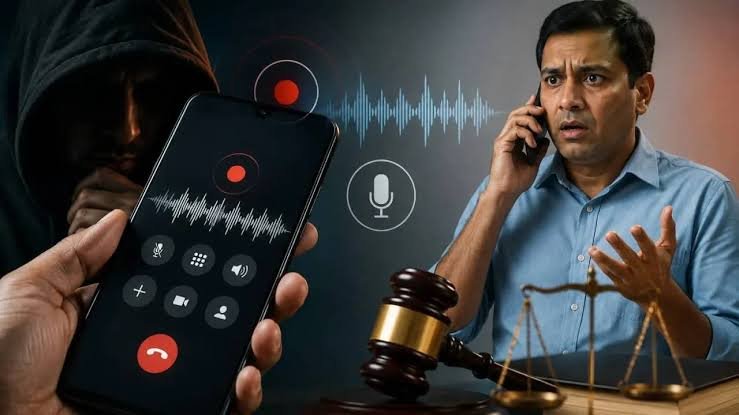
The Core Rule: One-Party Consent
- If you’re a participant in the conversation, you can legally record it, even without informing the other party. This principle traces back to a foundational 1973 Supreme Court ruling, M. Malkani v. State of Maharashtra, where the Court held that the right to privacy protects innocent people, not those seeking to evade legitimate scrutiny — and recording a call you’re personally part of doesn’t constitute an unlawful privacy violation.
- Recording a call you are NOT a participant in — secretly intercepting someone else’s conversation — is illegal. This directly implicates Article 21 of the Constitution (the right to privacy) and is reinforced by a separate landmark case, PUCL v. Union of India (1997), which established strict limits on telephone interception and surveillance.
- This distinction is genuinely the crux of the entire legal picture: your own participation in the call is what makes recording it lawful. The moment you’re recording a conversation between two other people without either of their consent, you’ve crossed into clearly illegal territory.
The Legal Framework Behind This
- The Telecommunications Act, 2023, specifically Section 20, now governs call interception in India, having replaced the Indian Telegraph Act, 1885, which previously served this function. This provision prohibits intercepting a communication without the consent of at least one participant — meaning interception is permitted precisely when one person on the call (which can be you, the recorder) has consented, but not otherwise.
- The Information Technology Act, 2000 also plays a role, since a call recording constitutes an “electronic record” under the Act. Section 66E addresses unauthorized access to or capture of private communications, and Section 72 addresses breach of confidentiality and privacy — both of which can apply when a recording is made or used without proper authorization.
- Article 21 of the Constitution underpins all of this, since Indian courts have consistently treated unauthorized interception of private communications as a fundamental rights violation, not merely a statutory one.
What Happens If You Record Someone Illegally
- A third party recording your call without your knowledge or consent, where you’re not a participant and neither party consented, can amount to a serious privacy violation and may constitute an offence under the IT Act and the Telecommunications Act framework.
- Courts, including the Delhi High Court, have specifically held that unauthorized call recording violates the fundamental right to privacy, giving an affected person grounds to pursue legal action and seek compensation for the violation.
- Misusing a legally obtained recording — for instance, sharing a recording of a call you were part of with third parties without the other person’s consent, particularly in a way intended to harass or embarrass them — can separately trigger privacy and defamation-related legal consequences, even though the original act of recording itself was lawful.
Call Recording in Business and Workplace Settings: A Different, Stricter Standard
This is where the legal picture genuinely diverges from the simple personal one-party consent rule, and it’s worth understanding separately.
- For businesses, call centers, and commercial call recording (customer service lines, sales calls, etc.), the Digital Personal Data Protection Act (DPDP Act) introduces considerably stricter requirements than the traditional one-party consent standard.
- Under the DPDP Act, organizations must obtain consent that is explicit, purpose-specific, and properly disclosed — not simply implied by the caller continuing the conversation after a generic “this call may be recorded” announcement buried in terms and conditions. Consent must be:
- Free from coercion — no implied negative consequence for declining
- Specific to the purpose (quality assurance, training, compliance, etc.)
- Informed, with clear disclosure, not hidden in fine print
- Unambiguous — requiring an affirmative action, not mere silence
- Sharing call recordings with third parties requires separate consent beyond whatever consent covered the original recording, unless that sharing was explicitly disclosed as part of the original purpose.
- This means a business cannot simply rely on the personal “I’m a participant so I can record” principle the way an individual can — commercial recording of customer or employee calls now carries genuine compliance obligations under India’s dedicated data protection law.
Are Call Recordings Admissible as Evidence in Court?
- Yes — a call recording made by a participant in the conversation is generally admissible as evidence, provided it meets standard evidentiary requirements (authenticity, relevance, and proper handling as electronic evidence under applicable law).
- This applies equally to recordings of regular phone calls and to things like WhatsApp voice messages or call recordings, which are treated similarly as electronic records for evidentiary purposes.
A Quick Reference for Common Scenarios
- Recording your own phone call — Legal (one-party consent)
- Recording a meeting you’re personally attending — Legal (one-party consent)
- Secretly recording a conversation between two other people that you’re not part of — Illegal
- A business recording customer service calls without proper DPDP-compliant disclosure and consent — Legally risky, potentially non-compliant
- Sharing a legally recorded call with third parties to harass or embarrass someone — Can trigger separate privacy and legal consequences, even if the original recording was lawful
Frequently Asked Questions
Q1. If I record a phone call with a friend without telling them, can they take legal action against me?
Generally no, provided you were an actual participant in the call — India’s one-party consent principle, established through the 1973 Malkani case, means you don’t need to inform the other party to legally record a conversation you’re personally part of.
Q2. Can my employer legally record my work calls without telling me?
This depends on the specific circumstances and increasingly on DPDP Act compliance — if your employer is a participant through a monitoring system with proper disclosure in your employment agreement, this is typically permissible, but recording without any disclosure or consent framework, especially for commercial/business purposes, raises compliance concerns under the stricter standards now applying to organizational call recording.
Q3. Is it legal to record a call and then share it publicly or with someone else without the other person’s permission?
The original recording itself may be legal if you were a participant, but sharing or publishing that recording, particularly in a way that harasses, embarrasses, or violates the other person’s reasonable expectation of privacy, can separately trigger legal consequences even though the recording itself wasn’t unlawfully made.
Q4. Does the Telecommunications Act, 2023 change the basic one-party consent rule that existed under the older Telegraph Act?
No — the core one-party consent principle remains the same; the Telecommunications Act, 2023 (specifically Section 20) essentially modernized and replaced the interception framework previously governed by the 1885 Telegraph Act, but the underlying rule that interception is prohibited without at least one participant’s consent continues to apply.